We have all been there: staring at a glowing computer screen with forty-two browser tabs open, three different digital project management tools pinging simultaneously, and a sticky note graveyard surrounding our monitor. Despite having more productivity apps at our fingertips than any generation in human history, many of us feel more scattered, overwhelmed, and mentally exhausted than ever.
Enter the antidote to digital clutter: the minimalist daily planner whiteboard for the office.
While it might sound counterintuitive in a hyper-digitized world to revert to a physical writing surface, the modern office whiteboard has undergone a quiet revolution. Stripped of plastic frames, garish corporate logos, and overwhelming gridlines, the minimalist daily planner whiteboard is equal parts functional productivity tool and sophisticated architectural statement.
If you are looking to optimize your workspace, command higher focus, and invest in a tool that genuinely shifts how you work, understanding the psychology, design anatomy, and practical magic of minimalist whiteboards is your first step.
1. The Modern Productivity Crisis: Why Digital Tools Are Failing Us
To truly appreciate the value of a physical planning board, we must first diagnose why our current systems are breaking down. Over the past decade, the corporate and freelance worlds have rushed headfirst into digital transformation. We use cloud apps, automated reminders, time-tracking software, and complex kanban boards.
Yet, cognitive fatigue is at an all-time high. Why?
- Notification Fatigue: Every digital tool demands your attention through pings, badges, and pop-ups. Your computer screen is an arena of constant interruption.
- The Illusion of Progress: Organizing tasks in a digital app often feels like work, but it is frequently a form of sophisticated procrastination. Rearranging digital cards gives us a dopamine hit without requiring any actual cognitive exertion or execution.
- Out of Sight, Out of Mind: Digital to-do lists are easily hidden behind minimized windows. They lack physical presence, meaning they don’t hold space in your environment or demand accountability from you throughout the day.
When your workspace lacks physical anchors, your mind floats aimlessly between open tabs. This is where tactile, analog tools like a minimalist daily planner whiteboard reclaim their throne.

2. The Cognitive Science of Analog: Why Writing Things Down Changes Your Brain
To understand why a physical whiteboard works so effectively, we have to look at cognitive science. Digital tools are fantastic for storage, searchability, and collaboration across oceans. However, they are notoriously terrible for deep focus.
When you type a task into a digital app, the action is abstracted. You press a glass screen or a plastic key, and the text instantly standardizes into a generic font. Your brain processes this as a low-friction, easily dismissible action.
Conversely, tactile writing engages the reticular activating system (RAS)—the network in your brain that filters out unnecessary information and prioritizes what you are currently focusing on.
The Power of Permanence and Movement
Erasing a word and writing a new one requires physical movement. You feel the drag of the marker; you watch the ink dry. This physical investment forces your brain to internalize priorities. When you physically write out “Finish Quarterly Report” with your own hand, your nervous system registers that commitment differently than a keystroke.
Cognitive Offloading Without Noise
Computer screens demand constant interaction (scrolling, clicking, minimizing). A physical whiteboard sits quietly in your peripheral vision, acting as an external hard drive for your working memory. It does not ping, it does not require software updates, and it cannot crash. It offers pure, unadulterated clarity every time you lift your gaze from your monitor.

3. Anatomy of a True Minimalist Planner Whiteboard
Not all whiteboards are created equal. The traditional, cheap aluminum-framed boards found in corporate conference rooms in the 1990s are relics of the past. They warp, stain, attract dust, and look decidedly uninspiring in a modern, curated home office or executive desk setup.
A true minimalist daily planner whiteboard designed for a modern office possesses distinct characteristics:
Frameless or Ultra-Thin Profiles
The hallmark of minimalism is the absence of visual noise. Look for frameless glass boards or boards with ultra-slim, matte-finished anodized aluminum or wood frames. They should blend seamlessly into your wall paint or back panel, looking like a piece of modern art rather than a corporate utility.
Intentional, Ghost-Free Layouts
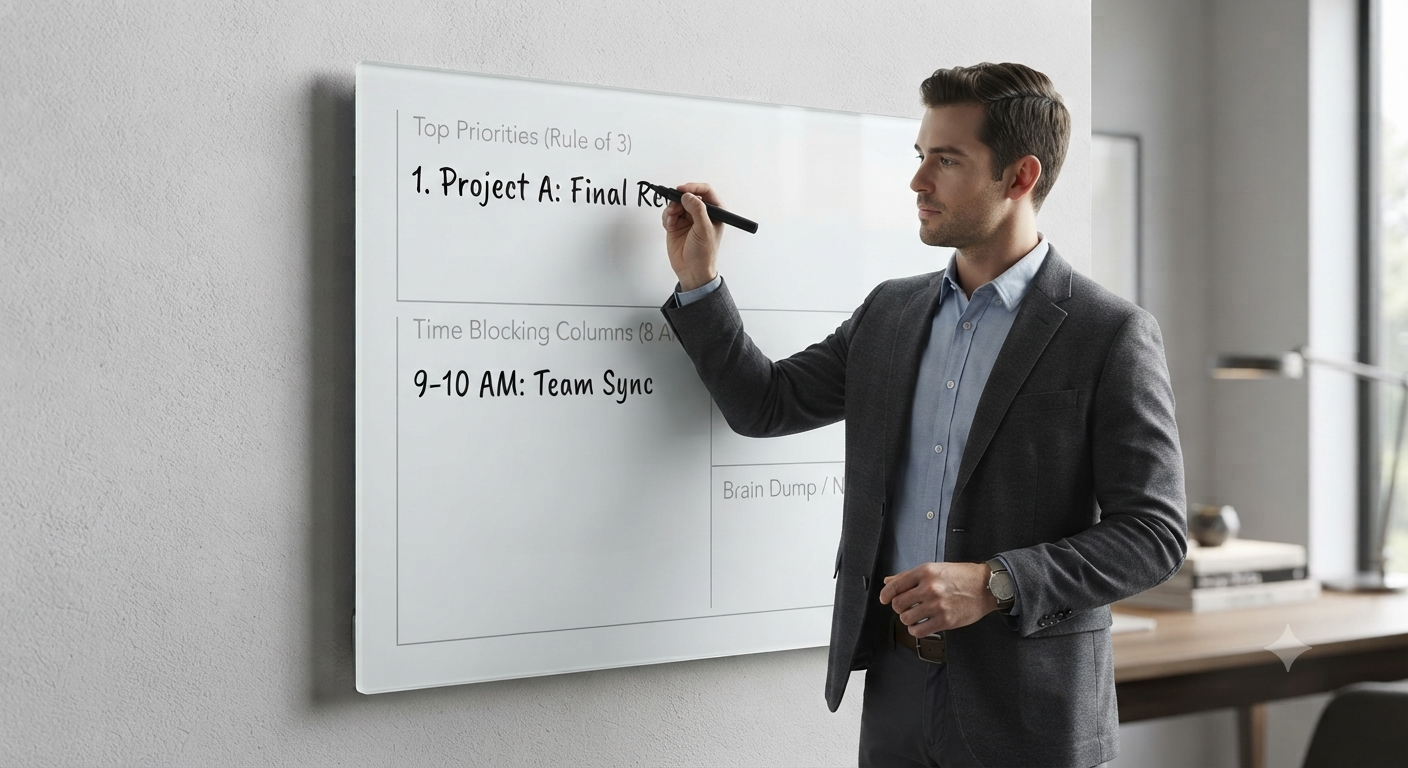
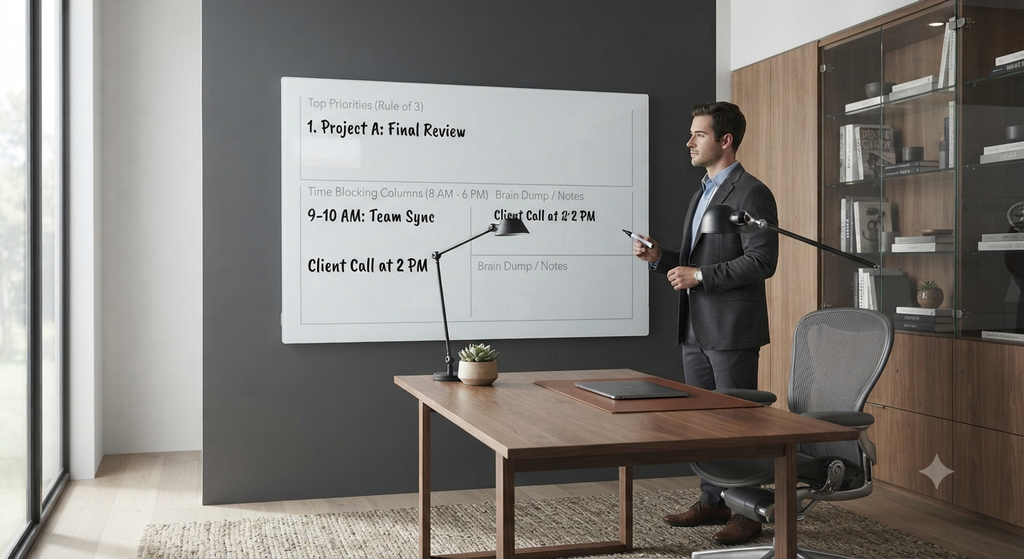
A minimalist board avoids chaotic, rainbow-colored grids and cluttered calendars. Instead, it features subtle, laser-etched, or faint gray typography dividing the surface into core daily sections:
- Top Priorities (The Rule of 3): Dedicated space for the three non-negotiable tasks of the day.
- Time Blocking Columns: A clean vertical timeline from morning to evening to map out deep work sessions.
- Brain Dump / Notes Section: An open canvas for sudden ideas, phone numbers, or quick sketches that need sorting later.
Premium Materials: Glass vs. Porcelain Steel
High-end minimalist boards are typically made from tempered acoustic glass or porcelain-coated steel. Unlike cheap melamine or painted hardboard, glass whiteboards never ghost, stain, or scratch. They maintain their pristine, crystal-clear appearance for years, making them a sustainable, lifetime investment for your workspace.
4. High-Value Workspace Integration: Styling Your Office
Beyond productivity, a well-chosen office accessory acts as an anchor for your interior design. Because high-end minimalist whiteboards look exceptionally chic, they elevate the entire aesthetic of a home office or executive suite.
- Color Palette Synergy: Pair a white or frosted glass board with matte black hardware and accessories. Use liquid chalk markers in earthy tones (sage green, muted charcoal, terracotta, warm taupe) rather than blinding neon colors to maintain a calm, high-end, distraction-free atmosphere.
- Strategic Ergonomic Placement: Mount the board at eye level directly adjacent to your primary monitor (either on the wall or via desktop slant stands). This positioning ensures that glancing at your daily plan requires only a natural turn of the head, keeping you in your workflow state without breaking your physical posture or requiring you to swivel your chair entirely.
- Lighting and Reflection Management: If you choose a gloss glass whiteboard, consider how natural light hits it. Placed near a window, a frameless glass board catches the light, casting subtle, elegant shadows and giving your office an airy, spacious architectural feel.
5. Crafting Your Daily Ritual: How to Master Your Planning Board
A tool is only as good as the habits built around it. To maximize the value of your minimalist daily planner whiteboard, you need to establish a structured, repeatable daily ritual.
Step 1: The Evening Reset (The 5-Minute Close)
Never leave your office without resetting your board. Before you log off for the day, wipe the board clean. Review what was accomplished, migrate unfinished tasks thoughtfully, and write down your top three priorities for the next morning. Walking into a clean office with tomorrow already mapped out eliminates morning anxiety and decision fatigue.
Step 2: Embrace Physical Constraints
Minimalist boards have limited physical space. This is a feature, not a bug. It forces you to ruthlessly prioritize. If it doesn’t fit on the board, it doesn’t happen today. Learn to say no to trivial tasks that dilute your focus.
Step 3: The Dopamine Hit of the Big Erase
There is an undeniable psychological satisfaction in physically wiping away a completed task with a microfiber cloth. It provides a micro-dose of dopamine, closing the psychological loop on completed work and preparing your mind to transition smoothly to the next challenge.

6. Comparing Productivity Systems: Digital vs. Analog Whiteboards
To help you decide how to integrate a minimalist whiteboard into your current workflow, let’s look at how it stacks up against traditional productivity mediums across key factors:
As this comparison illustrates, the whiteboard occupies a unique sweet spot: it gives you the tactile, focus-driving benefits of a paper notebook combined with the macro-level visibility of a dashboard—all while keeping your digital workspace clean.
7. Psychological Benefits of Visualizing Your Workflow
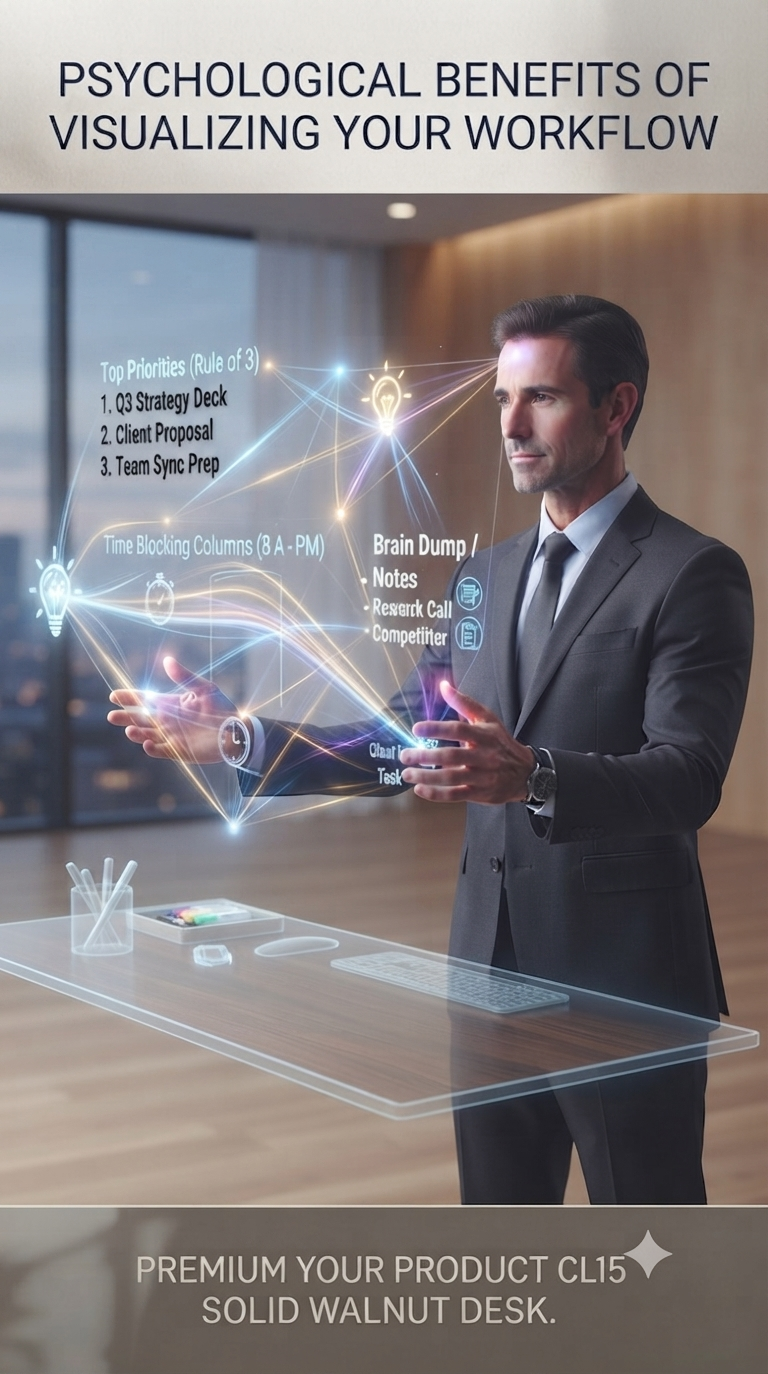
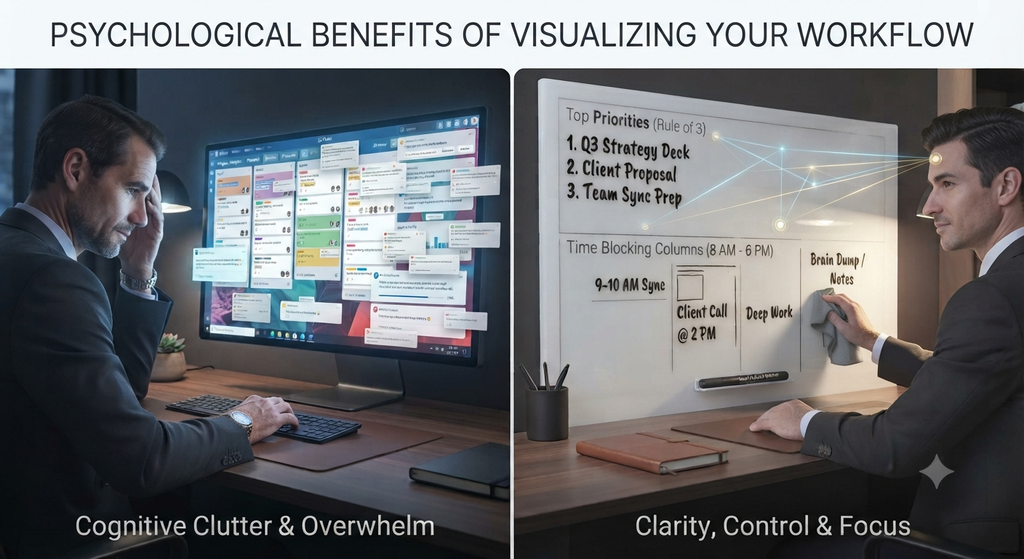
When your tasks are physically projected onto a wall or desk board in front of you, a psychological phenomenon known as external cognition takes place.
By removing tasks from your brain’s working memory and placing them in your immediate physical environment, you free up massive amounts of cognitive bandwidth. You no longer waste mental energy trying to remember what you were supposed to do next or worrying that you forgot something important. Your brain relaxes because it trusts the external system you have built.
Furthermore, seeing your day laid out linearly prevents time blindness. When you block out specific hours for deep work, emails, and meetings on a physical timeline, you realize just how finite your day actually is. This stark, visual reality check cures chronic over-scheduling and forces you to respect your own time.
8. Selecting the Right Board for Your Specific Office Layout
Choosing the right minimalist planner whiteboard depends heavily on your workspace dimensions and working style:
- Wall-Mounted Glass Panels: Ideal for dedicated home offices or private corporate rooms. They free up precious desk real estate and become a stunning focal point on an accent wall.
- Desktop Slanted Whiteboards: Perfect for sit-stand desks or open-plan offices where wall mounting isn’t an option. These boards sit at an ergonomic angle right between your keyboard and monitor, doubling as a keyboard riser or document holder.
- Magnetic Modular Boards: If you need flexibility, modular magnetic boards allow you to snap together your daily planner section alongside a small cork or felt pin strip for ultimate versatility.

Investing in Mental Clarity and Sustainable Focus
In an era where attention is the world’s most valuable currency, clearing the clutter from your field of vision is a radical act of self-preservation. A minimalist daily planner whiteboard for your office does more than track tasks—it changes your relationship with time, eliminates digital fatigue, and turns daily execution into an aesthetic ritual.
By replacing notification-heavy digital clutter with a clean, physical canvas, you reclaim control over your day, protect your mental energy, and build a sanctuary of focused productivity. If you are ready to transform your workspace from a chaotic digital maze into a high-performance studio, upgrading to a minimalist planning surface is the single best investment you can make this year.
What aspect of your current daily planning routine do you find most frustrating—digital distraction or physical clutter?