Transforming your home office into a thriving, restorative space often comes down to the finishing touches. While ergonomic chairs, high-end monitors, and meticulous cable management form the physical backbone of your workflow, they can easily leave a room feeling sterile and clinical. Enter indoor greenery—the ultimate biophilic upgrade.
For many remote professionals and digital creators, however, the primary hurdle isn’t a lack of desire for plants; it is a lack of natural light. Not every home office boasts floor-to-ceiling southern exposure. Many workspaces are tucked into corners, basement conversions, or rooms with small, north-facing windows.
Fortunately, thriving indoors doesn’t require a greenhouse. Mother Nature has engineered an elite class of shade-tolerant flora that not only survive in dim environments but genuinely flourish there. By strategically integrating these resilient species, you can elevate your workspace aesthetics, boost your cognitive performance, and purify your air without ever worrying about harsh sun scorch.
Why Low-Light Plants Belong on Your Desk
Before diving into the botanical catalog, it helps to understand the science behind why bringing plants into your workspace changes your daily output.
1. The Biophilic Boost and Stress Reduction
Biophilia—our innate human tendency to seek connections with nature—plays a massive role in our psychological well-being. Studies in environmental psychology consistently show that having living plants within your field of view lowers cortisol levels, reduces mental fatigue, and blunts the physiological impacts of a high-stress workday. When a deadline is looming, glancing at a soft, cascading leaf structure provides a micro-rest for your nervous system.
2. Natural Air Filtration
Indoor air quality is notoriously lower than outdoor air, often trapping volatile organic compounds (VOCs) emitted by synthetic carpets, paints, office furniture, and electronics. While you would need an indoor jungle to completely replace an HVAC system, many low-light desk plants are certified champions at absorbing toxins through their leaves and roots, subtly cleaning the micro-climate right around your monitor.
3. Humidity and Acoustic Softening
Hard surfaces dominate modern home offices: glass desks, metal monitor arms, and laminate flooring create an acoustically harsh environment that amplifies typing sounds and echoes. Plants naturally diffuse sound waves and transpire moisture, helping to counter the dry air often caused by heating and air conditioning units.
Understanding “Low Light” in Interior Spaces
When plant labels or guides mention “low light,” it is crucial to define what that actually means. In horticultural terms, low light does not mean complete darkness or a windowless room with only artificial overhead fluorescent bulbs (unless you are using specialized horticultural grow lights).
Instead, true low-light conditions typically refer to:
- North-facing windows: Which receive cool, indirect light throughout the day.
- East-facing rooms: Where gentle morning sun hits for a couple of hours, followed by shade.
- Interior spaces: Placed 6 to 10 feet away from a bright window, where the sun’s direct rays never touch the leaves.
If your office relies entirely on artificial lighting during work hours, most plants will struggle long-term without an occasional break near a window or the assistance of a full-spectrum LED desk lamp. Keep this baseline in mind as we explore the best species for your desk ecosystem.

The Ultimate Low-Light Desk Plants for High-Value Productivity
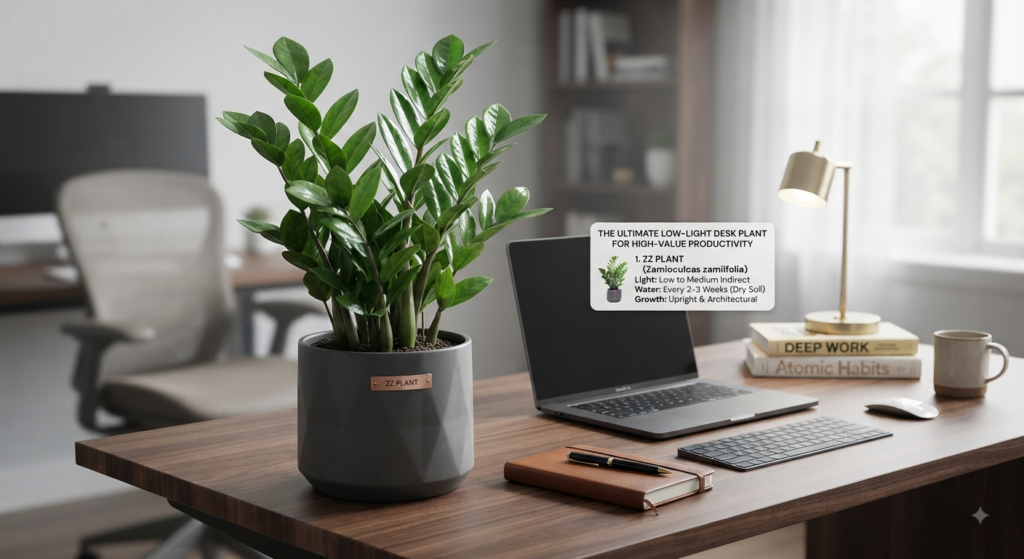
1. ZZ Plant (Zamioculcas zamiifolia)
- Light Requirement: Low to medium indirect light (thrives under fluorescent office lights).
- Watering Frequency: Every 2 to 3 weeks (allow soil to dry completely).
- Growth Habit: Upright, architectural, and slow-growing.
If there is a monarch of indestructible office plants, it is the ZZ Plant. Characterized by its thick, waxy, emerald-green leaves, the ZZ plant looks almost artificial because of its immaculate sheen. It stores water in subterranean potato-like rhizomes, making it extraordinarily forgiving if you forget to water it while chasing a tight deadline.
Why it works on a desk: Its vertical, clean-lined growth habit takes up minimal horizontal desk space while adding a sophisticated, architectural silhouette. It doesn’t drop leaves, meaning zero mess near your mechanical keyboard or mouse pad.
2. Snake Plant (Sansevieria trifasciata / Dracaena trifasciata)
- Light Requirement: Extremely adaptable, from low indirect light to partial shade.
- Watering Frequency: Every 3 to 4 weeks; drought-tolerant.
- Growth Habit: Vertical, sword-like, rigid leaves.
The Snake Plant (often affectionately called “Mother-in-Law’s Tongue”) is legendary for its resilience. What makes it particularly valuable for a modern home office is its unique physiological ability: unlike most plants that release oxygen during the day and carbon dioxide at night, snake plants perform crassulacean acid metabolism (CAM), releasing oxygen and absorbing carbon dioxide throughout the night. Placing one near your workspace ensures a constant, fresh supply of oxygen during those late-night grinding sessions.
Styling tip: Opt for a dwarf variety like Sansevieria Hahnii (Bird’s Nest Snake Plant) if you are working with a compact setup. It stays short, neat, and compact, fitting effortlessly next to a desk organizer or pen holder without blocking your screen view.

3. Cast Iron Plant (Aspidistra elatior)
- Light Requirement: Deep shade to low indirect light.
- Watering Frequency: Every 10 to 14 days.
- Growth Habit: Broad, lance-shaped, dark green arching leaves.
True to its name, the Cast Iron Plant earned its reputation during the Victorian era because it seemed impervious to neglect, pollution, dim Victorian parlor lighting, and irregular watering. It features rich, glossy, dark green leaves that unfurl gracefully, adding a lush, tropical touch to otherwise stark workspaces.
Why it works on a desk: It is exceptionally slow-growing, meaning you won’t have to worry about constant pruning or repotting. It handles fluctuating indoor temperatures and lower humidity levels with ease.
4. Pothos (Epipremnum aureum – Varieties like ‘Neon’ or ‘Marble Queen’)
- Light Requirement: Low to bright indirect light (though variegation fades slightly in deep shade).
- Watering Frequency: Every 1 to 2 weeks (when top 2 inches of soil are dry).
- Growth Habit: Trailing, cascading vines.
Pothos is widely considered the ultimate gateway plant for beginners, and for good reason. Its heart-shaped leaves trail down gracefully, making it an exceptional choice if your desk setup features floating shelves, a hutch, or a tall bookcase.
While variegated types prefer a bit of brightness to maintain their cream or golden splashes, solid green varieties like the Jade Pothos or dark-toned cultivars handle low-light desk corners with absolute ease.
Productivity tip: Letting vines frame your monitor or spill softly down the side of your desk creates a cozy, enclosed “cocoon” effect that helps reduce visual distractions in an open-plan home.

5. Peace Lily (Spathiphyllum)
- Light Requirement: Low to medium indirect light.
- Watering Frequency: Weekly (they dramatically droop when thirsty and bounce right back).
- Growth Habit: Lush, bushy foliage with elegant white spathe flowers.
If you want a plant that breaks up the sea of green with occasional splashes of pristine white, the Peace Lily is your best bet. It is famously shade-tolerant—in fact, direct sunlight will quickly burn its delicate leaves.
Peace lilies are also celebrated NASA Clean Air study participants, noted for effectively scrubbing indoor air pollutants like benzene, formaldehyde, and carbon monoxide.
Watering indicator: One of the most satisfying features of the Peace Lily for busy professionals is its communication style. When it needs water, the entire plant will dramatically slump over as if taking a nap. Within hours of a thorough watering, it stands straight up again. It takes the guesswork entirely out of plant care.
6. Aglaonema (Chinese Evergreen – Varieties like ‘Silver Bay’ or ‘Red Siam’)
- Light Requirement: Low indirect light to medium shade.
- Watering Frequency: Every 1.5 to 2 weeks.
- Growth Habit: Compact, bushy, with broad, stunningly patterned leaves.
Do not let the sophisticated, vibrant patterns of the Chinese Evergreen fool you into thinking it is a high-maintenance diva. While cultivars with bright pink or red splashes prefer a bit of ambient light, darker green and silver varieties like ‘Silver Bay’ tolerate remarkably low-light office corners.
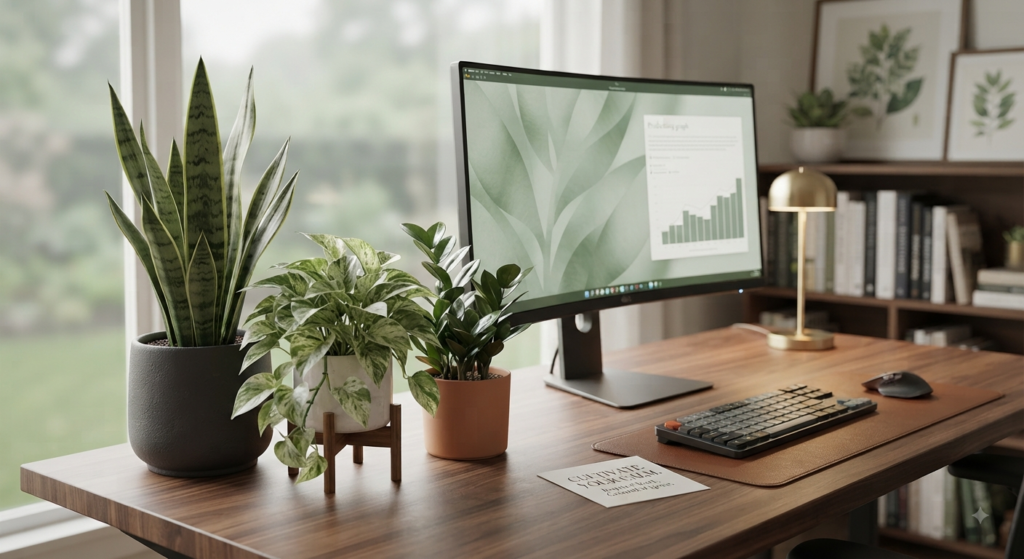
Their multicolored foliage injects a dose of interior design flair into a neutral desk palette, pairing beautifully with walnut wood finishes, leather desk mats, and matte black accessories.
Crafting the Aesthetic: How to Style Low-Light Plants on Your Desk
Having the right plant is only half the battle; integrating it harmoniously into your workspace design dictates whether your desk feels cluttered or curated. Here are professional styling strategies to maximize both space and visual appeal:
1. Match Your Hardware and Planter Materials
To keep your desk looking cohesive, match your planters to your existing hardware.
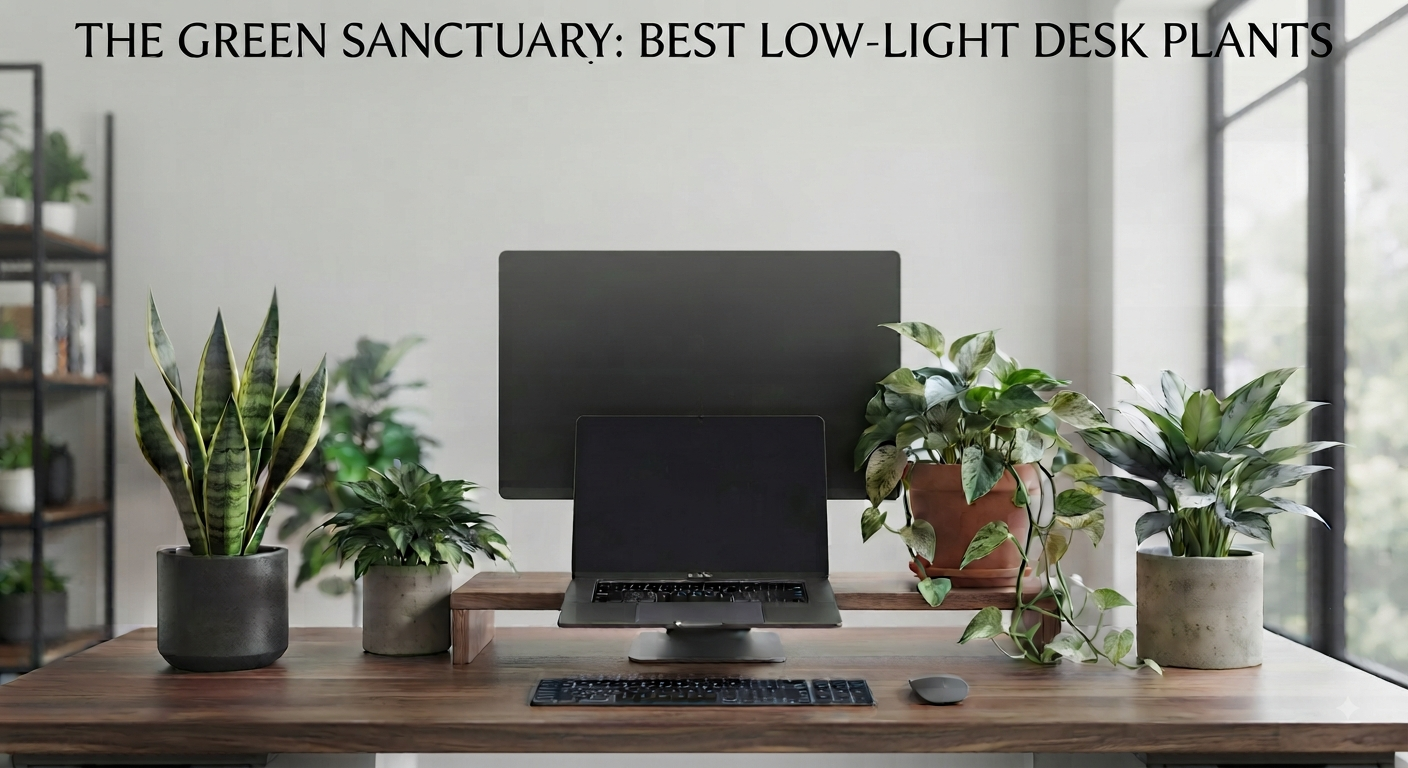
- If your setup features matte black monitor arms and a minimalist aluminum laptop stand, choose concrete, charcoal ceramic, or matte black planters.
- If your aesthetic leans warm and organic with solid wood monitor stands and leather accessories, opt for terracotta, stoneware, or woven rattan cachepots.
2. Vertical Tiering and Spatial Economy
Desk real estate is precious. If every square inch is occupied by your keyboard, notepad, coffee cup, and stream deck, a large potted plant will quickly become a nuisance.
- Utilize vertical space by mounting small floating shelves directly above your monitors.
- Invest in minimalist geometric wall-mounted pockets or magnetic planters that attach to metal desk legs or PC towers.
- Use narrow, tall cylindrical pots rather than wide, bulbous bowls to minimize your plant’s footprint on the desk surface.

Troubleshooting Common Low-Light Desk Plant Issues
Even the hardiest plants occasionally send out distress signals. Here is how to diagnose and fix common home office plant ailments quickly:
Final Thoughts: Cultivating Your Calm
Your home office should be more than just a functional command center; it should be a space that inspires you, grounds you, and protects your mental energy during long stretches of deep work.
By introducing shade-tolerant champions like the resilient ZZ Plant, the air-purifying Snake Plant, or the cascading vines of a Pothos, you bridge the gap between productivity and natural tranquility. You don’t need a sunroom or a green thumb to cultivate a thriving workspace—just a smart selection of low-light varieties tailored to your desk environment.
Pick your favorite, clear a small patch next to your monitor, and watch how a touch of green transforms your entire workday.