The modern executive workspace has undergone a profound psychological and aesthetic evolution. Gone are the days when a high-powered desk required heavy, ornate mahogany furniture, cluttered credenzas, and walls choked with traditional framed diplomas or loud, chaotic abstract paintings. Today’s high-value professional environment—whether situated in a sleek corner office on the 40th floor or a meticulously curated home study—thrives on a singular design philosophy: quiet luxury.
At the center of this evolution is the role of vertical space. While your desk anchors your daily productivity, your walls frame your mental state. Minimalist executive desk wall art is not merely about filling an empty gap above your monitor or credenza; it is a strategic discipline in visual ergonomics. It serves as an intentional anchor that promotes deep focus, projects understated authority, and balances clean architectural lines with emotional resonance.
This comprehensive guide explores the philosophy, curation strategies, psychological impacts, and styling methodologies behind selecting and implementing high-end minimalist wall art tailored specifically for executive desks.
Part 1: The Psychology of the Executive Minimalist Workspace

To understand why minimalist wall art commands such powerful visual authority, we must first examine how our immediate physical environment dictates cognitive performance.
Cognitive Load and Visual Noise
The human brain is a continuous processing machine. Every object, color contrast, and line in your peripheral vision consumes a fraction of your mental bandwidth. In high-stakes executive roles—where strategic decisions, financial forecasting, and complex problem-solving are daily occurrences—cognitive fatigue is the ultimate enemy.
Cluttered, loud, or poorly proportioned wall art acts as persistent visual noise. It triggers micro-distractions that subconsciously chip away at sustained attention spans. Conversely, minimalist executive wall art operates on the principle of negative space. By utilizing clean geometries, muted monochromatic palettes, or subtle textural shifts, minimalist pieces give the eye—and by extension, the brain—a place to rest.
Projecting Authority Through Restraint
In classical design, excess was synonymous with wealth. In contemporary executive design, restraint is the ultimate status symbol.
- First Impressions: When a client, partner, or colleague steps into your office, your walls communicate your corporate ethos before you even speak.
- Presence: A massive, aggressively ornate painting shouts for attention.
- Understated Power: A meticulously framed, large-scale minimalist piece whispers confidence, clarity, and deliberate control.
Minimalist executive wall art tells the viewer that you do not need visual clutter to prove your worth. Your decisions are precise, your vision is uncluttered, and your environment is governed by uncompromising standards of quality.
Part 2: Defining the Core Aesthetics of Minimalist Executive Art
Minimalism is often misunderstood as cold, sterile, or empty. True executive minimalism, however, is warm, tactile, and deeply intentional. When choosing wall art to position directly above or adjacent to an executive desk, consider these four foundational aesthetic pillars:
1. Architectural Line Art and Structural Minimalism
Rooted in the traditions of mid-century modern design and architectural drafting, structural line art uses minimal strokes to define complex forms.
- The Appeal: These pieces often feature continuous ink lines on heavy cotton rag paper, charcoal renderings of brutalist structures, or subtle metallic wire sculptures mounted on linen backings.
- The Executive Fit: They appeal to leaders who value systemic thinking, structural integrity, and clean execution. They bridge the gap between creative vision and rigid operational logic.
2. Monochromatic Textures and Reliefs
When color is stripped away, texture takes center stage. Monochromatic wall art relies on physical depth rather than pigment to create visual interest.
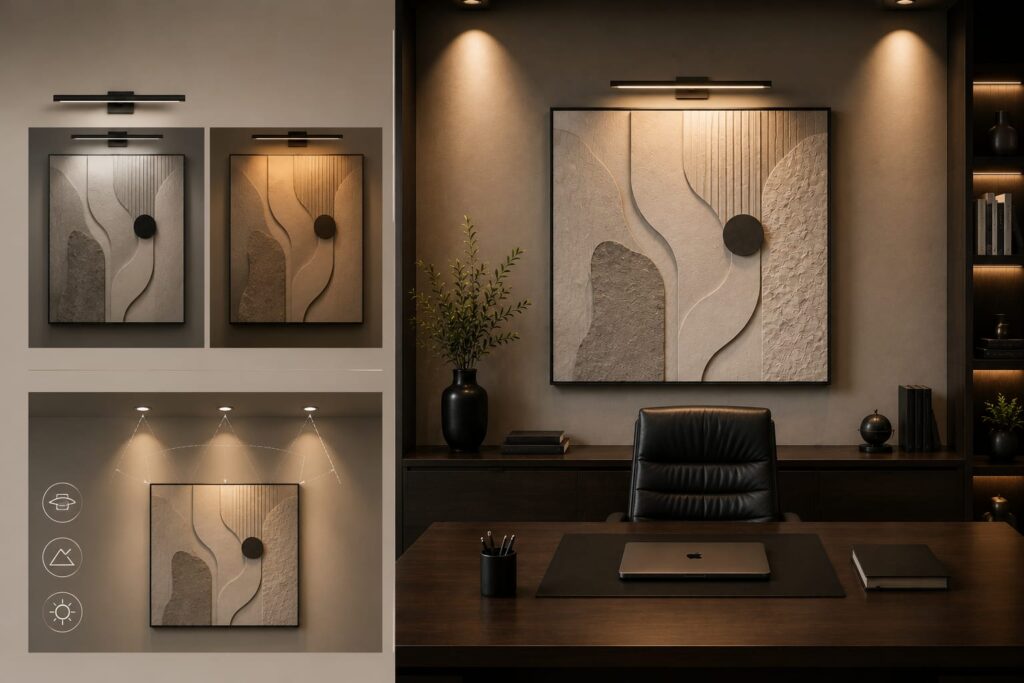
- The Appeal: Think heavy plaster reliefs, raw linen stretched over custom wooden chassis, cast paper sculptures, or subtle lime-wash finishes. As natural light shifts across your office throughout the day—from morning sun to evening shadows—these pieces interact with the light, casting delicate micro-shadows that change the mood of the room.
- The Executive Fit: Perfect for high-stress environments where a calming, tactile connection to natural materials grounds the user.
3. Subdued Tonal Landscapes and Horizon Art
Nature has long been a source of executive contemplation. However, vibrant, tropical sunsets or detailed forest photographs can feel too casual or domestic for an executive workspace.
- The Appeal: Tonal landscapes strip nature down to its barest emotional essence. Think of a massive, foggy coastline rendered in whisper-quiet shades of slate gray, warm taupe, and muted sage. Or a minimalist horizon line dividing a pale cream sky from a charcoal sea.
- The Executive Fit: These pieces evoke vastness, long-term vision, and tranquility. They provide a psychological mental escape during high-pressure conference calls or intense contract negotiations.
4. Typography and Conceptual Minimalism
For the executive whose work revolves around ideas, strategy, and language, conceptual art can be a powerful anchor.
- The Appeal: Utilizing rare typography, architectural blueprint annotations, or minimalist cartography (such as abstract topographical elevation maps of major financial hubs), these pieces celebrate data, geography, and human innovation.
- The Executive Fit: They spark intellectual curiosity while maintaining a crisp, uncluttered visual standard.

Part 3: Spatial Geometry: Sizing and Positioning Above an Executive Desk
The most expensive piece of art will look amateurish if scaled or positioned incorrectly relative to your desk. Executive desks typically range from 60 inches to over 84 inches in width. Achieving visual equilibrium requires mathematical precision.
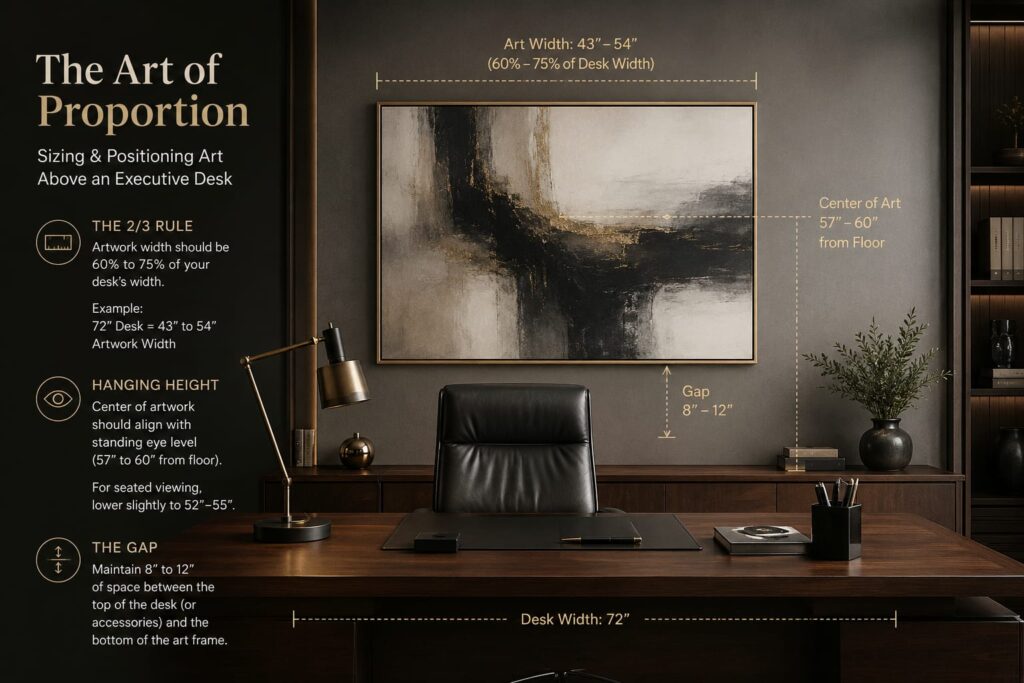
The 2/3 Rule of Desk-to-Art Proportions
Never let your wall art be wider than the desk beneath it. As a general rule of thumb:
- The combined width of your artwork (including framing) should occupy approximately 60% to 75% of the total width of your executive desk.
- Example: If you command a 72-inch walnut executive desk, your ideal wall art grouping or single large-scale statement piece should span between 43 and 54 inches wide.
Hanging Height and Sightlines
The vertical center of your artwork should align with your standing eye level—typically around 57 to 60 inches from the finished floor.
- When Seated: Executive desks often feature low-profile, ergonomic chairs where your seated eye level drops significantly. If the art is hung solely for your viewing pleasure while seated, you can drop the center point slightly (around 52 to 55 inches). However, if the office frequently hosts visitors, prioritize a standing or universal sightline.
- The Gap: Maintain a clean vertical breathing room of at least 8 to 12 inches between the top surface of your desk accessories (such as a monitor riser, desktop lamp, or bookshelf top) and the bottom edge of the art frame. This prevents the workspace from feeling cramped and claustrophobic.
Part 4: Framing and Materiality: The Details That Define Executive Quality
In minimalist design, because there are fewer elements to distract the eye, every single detail is magnified. The framing, glazing, and mounting of your minimalist executive wall art must reflect uncompromising craftsmanship.
Frame Selection
- Solid Hardwoods: Walnut, white oak, and ebonized ash are the holy trinity of executive desk aesthetics. Match your frame wood to your desk, bookshelves, or accent furniture to create a cohesive, custom-tailored environment. Avoid cheap veneers or high-gloss synthetic wraps.
- Architectural Metals: Brushed champagne brass, matte black anodized aluminum, or gunmetal steel can work exceptionally well if your hardware (desk legs, lighting fixtures, door handles) features industrial or metallic accents.
- Profile Width: Stick to slim-profile frames—typically between 0.375 inches and 0.75 inches wide with a deep face (shadow box style). This gives the art a modern, floating appearance while keeping the visual weight concentrated on the artwork itself.
Glazing and Protection
- Museum-Grade Acrylic / Glass: Standard picture glass creates distracting reflections from overhead recessed lighting and desk lamps. Invest in anti-reflective, UV-filtering museum glass or acrylic. It virtually eliminates glare, making the artwork appear as though it is completely open to the air while protecting high-end cotton papers and pigments from fading over decades of sunlight exposure.

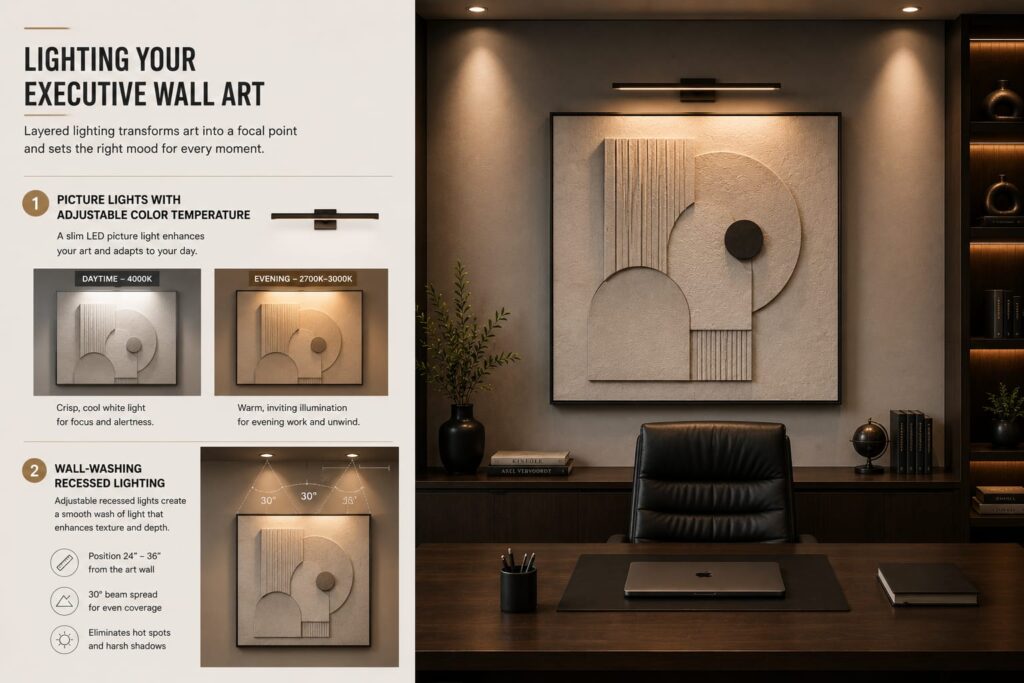
Part 5: Lighting Your Executive Wall Art
Art without light is invisible; art with poor lighting is distracting. In an executive office, lighting is layered to transition smoothly from high-focus daytime tasks to contemplative evening reviews.
1. Picture Lights with Adjustable Color Temperature
Install a slim, wireless or hardwired LED picture light directly above the frame. Look for fixtures with adjustable color temperature (CCT):
- Daytime (4000K): Crisp, cool white light that matches natural daylight, enhancing focus and alertness during peak working hours.
- Evening (2700K – 3000K): Warm, inviting illumination that softens the room, ideal for late-night strategy reviews or winding down administrative tasks.
2. Wall-Washing Recessed Lighting
If you are designing the office space from scratch, position adjustable recessed gimbal downlights roughly 24 to 36 inches away from the art wall, angled at a 30-degree beam spread. This creates a smooth “wall-washing” effect that accentuates textured reliefs and eliminates hot spots.
Part 6: Sourcing and Commissioning Bespoke Minimalist Pieces
High-end executives should avoid mass-produced, big-box retail prints. Your office represents your personal brand; your art should possess provenance and individuality.
1. Direct Studio Commissions
Reach out to contemporary independent artists who specialize in minimalist plaster reliefs, large-scale canvas minimalism, or architectural ink work. Commissioning a bespoke piece allows you to dictate exact dimensions, color matching with your office upholstery, and specific emotional tones.
2. Limited Edition Galleries and Print Houses
Curate through reputable fine art photography and print houses that offer certified limited runs (e.g., editions of 25 or 50 worldwide). Purchasing limited editions ensures that your office decor remains unique, sophisticated, and free from commercial ubiquity.