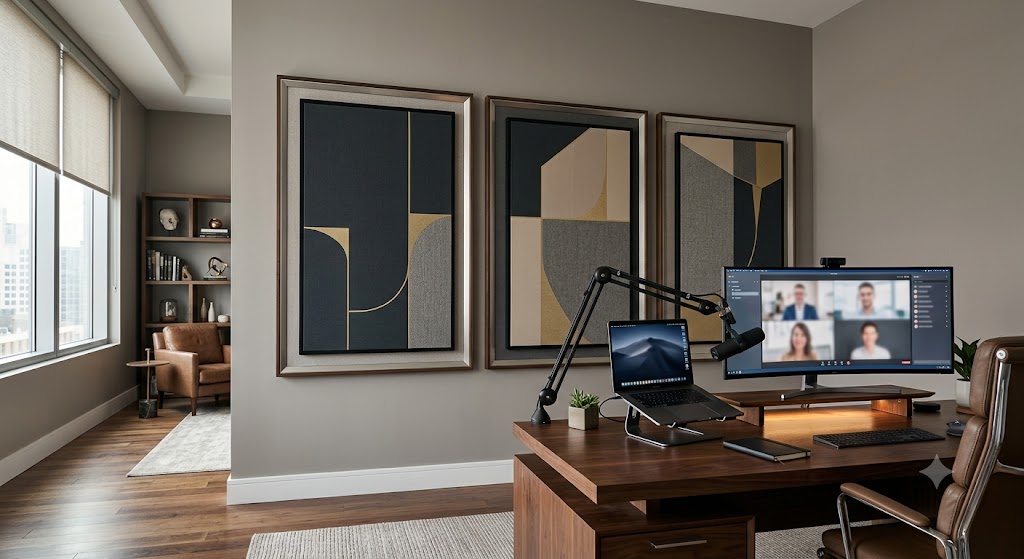
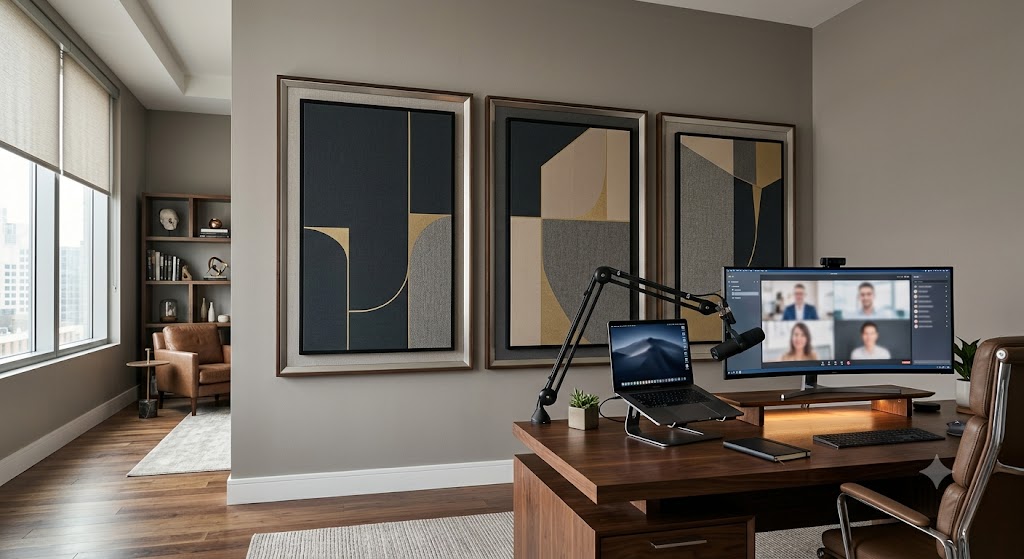
In the modern remote work ecosystem, the executive home office is no longer just a place to respond to emails—it is a command center, a broadcasting studio, and a physical extension of your professional brand. High-level executives, founders, and consultants spend hours each day on high-stakes video calls, virtual keynotes, and strategic board meetings. Yet, even the most impeccably furnished workspace can suffer from a hidden design flaw: poor acoustics.
Plush rug installations and thick hardwood desks do little to stop sound waves from bouncing off glass windows and drywall. The result is hollow, echoing audio that undermines your presence on video conferences. Traditional recording studio solutions, like grey foam wedges and raw fiberglass batts, compromise the sophisticated aesthetic required of an executive room.
Enter framed acoustic wall art. This design-forward solution marries studio-grade sound absorption with museum-quality gallery presentation.
2. The Silent Problem in High-End Workspaces
Modern executive interiors favor minimalist aesthetics: floor-to-ceiling glass, polished concrete, high ceilings, exposed brick, and sleek wooden furniture. While visually striking, these surfaces are acoustically reflective. Sound waves generated by your voice hit these hard boundaries and bounce back into the room, creating flutter echoes and reverberation.
When you speak during a video meeting, your microphone picks up both your direct voice and these delayed reflections. To listeners on the other side, your voice sounds distant, hollow, or muffled. Digital noise cancellation algorithms can filter out steady background sounds like air conditioning, but they struggle with complex vocal reflections. In attempting to cancel the echo, these algorithms often chop up your voice, causing dropped syllables and listener fatigue.
Poor acoustic quality subtly erodes perceived authority. Clear, warm, and natural vocal resonance conveys confidence and presence. Achieving high-quality audio requires managing the physics of sound within your physical room, starting with acoustic treatment.

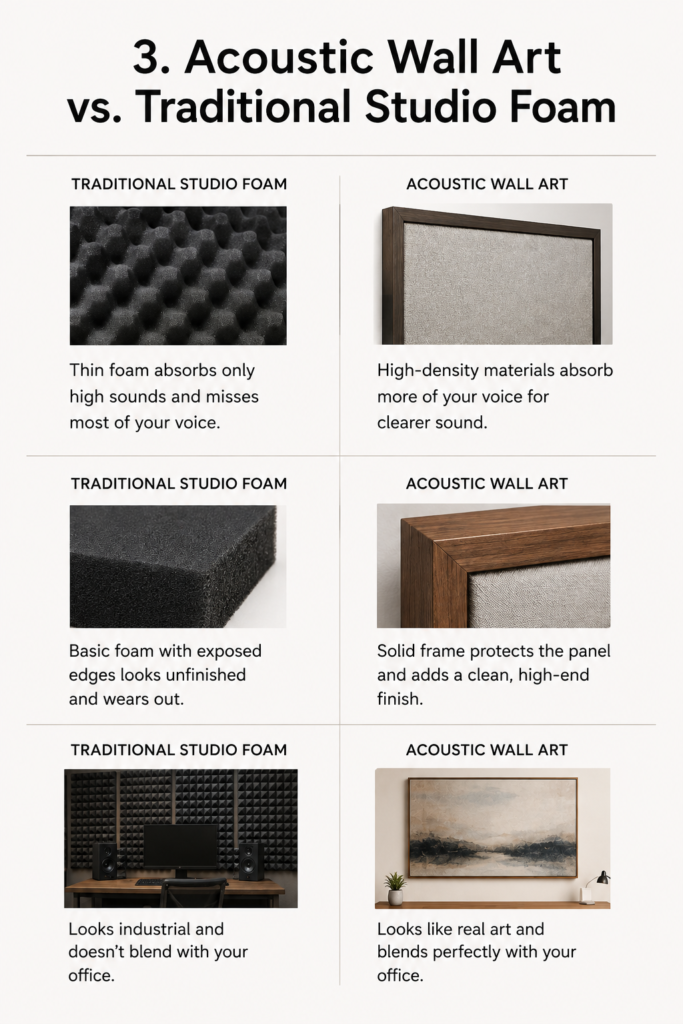
3. Acoustic Wall Art vs. Traditional Studio Foam
Many home office owners hesitate to implement sound treatment because they associate it with industrial recording environments or cheap foam squares. Understanding the differences between consumer foam, industrial acoustic panels, and framed acoustic art highlights why decorative treatments excel in executive spaces.
3.1 Material Density and Performance
Generic egg-crate foam relies on low-density polyurethane, which primarily absorbs very high frequencies (like harsh whistling or clattering keys) while leaving vocal mid-range frequencies virtually untouched. True executive-grade acoustic wall art uses high-density internal cores—typically open-cell acoustic felt, semi-rigid mineral wool, or dense recycled polyester fibers (PET). These materials offer consistent absorption across the speech spectrum, covering $250\text{ Hz}$ to $4000\text{ Hz}$.
3.2 Structural Integrity and Framing
Standard commercial panels are wrapped in fabric with exposed edges or basic internal wooden borders. Framed acoustic art utilizes furniture-grade exterior framing—such as solid walnut, matte anodized aluminum, or lacquered hardwood—which turns functional sound absorption into fine furniture. The solid frame also creates a defined border that protects the internal acoustic substrate from sagging over time.
3.3 Visual Integration
Instead of turning your office into a makeshift recording booth, custom acoustic artwork functions as a focal point. Modern printing techniques allow high-resolution artwork, architectural photography, or abstract designs to be dyed directly into acoustically transparent textiles without clogging the microscopic pores needed for sound wave penetration.
4. The Physics of Sound Absorption in Executive Spaces
To choose the right acoustic art for your space, it helps to understand the core metrics that govern sound control.
4.1 Noise Reduction Coefficient (NRC)
The efficiency of any acoustic treatment is rated using the Noise Reduction Coefficient (NRC), a scale ranging from $0.00$ (perfect reflection) to $1.00$ (perfect absorption). An NRC rating of $0.85$ means the panel absorbs $85\%$ of the sound energy that hits it, reflecting back only $15\%$. High-performing framed acoustic wall art typically carries an NRC between $0.75$ and $0.95$, depending on core thickness and framing depth.
4.2 Panel Depth and Frequency Control
The physical depth of the frame directly dictates the lowest frequency it can absorb:
- 1-Inch Deep Frames: Ideal for high-frequency flutter echo. Excellent for speech clarity in small to medium-sized rooms with heavy carpeting.
- 2-Inch Deep Frames: The sweet spot for executive offices. Absorbs lower-mid frequencies, including deeper vocal resonances, delivering balanced acoustic correction.
- 4-Inch Deep Frames (or 2-Inch with Air Gap): Used for large rooms with soaring ceilings or hard surface floors, capturing low-end rumble and lower frequencies.
Leaving a small air gap between the back of the acoustic panel and the drywall further increases low-frequency absorption without requiring a thicker frame.

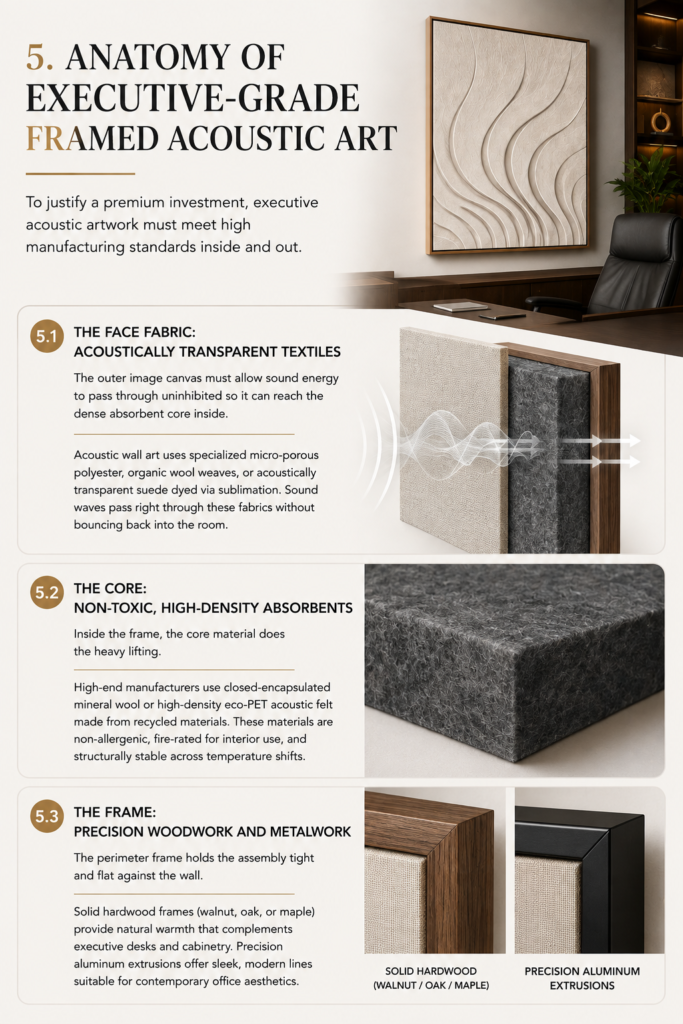
5. Anatomy of Executive-Grade Framed Acoustic Art
To justify a premium investment, executive acoustic artwork must meet high manufacturing standards inside and out.
5.1 The Face Fabric: Acoustically Transparent Textiles
The outer image canvas must allow sound energy to pass through uninhibited so it can reach the dense absorbent core inside. Standard canvas prints are sealed with gesso, acrylics, or heavy vinyl inks that create a hard, sound-reflective barrier. Acoustic wall art uses specialized micro-porous polyester, organic wool weaves, or acoustically transparent suede dyed via sublimation. Sound waves pass right through these fabrics without bouncing back into the room.
5.2 The Core: Non-Toxic, High-Density Absorbents
Inside the frame, the core material does the heavy lifting. High-end manufacturers avoid off-gassing materials or loose fiberglass. Instead, they use closed-encapsulated mineral wool or high-density eco-PET acoustic felt made from recycled materials. These materials are non-allergenic, fire-rated for interior use, and structurally stable across temperature shifts.
5.3 The Frame: Precision Woodwork and Metalwork
The perimeter frame holds the assembly tight and flat against the wall. Solid hardwood frames (walnut, oak, or maple) provide natural warmth that complements executive desks and cabinetry. Precision aluminum extrusions offer sleek, modern lines suitable for contemporary office aesthetics.
6. Designing Your Office with Acoustic Art
Integrating acoustic art into a high-end office requires balancing aesthetic impact with acoustic efficiency.
6.1 Selecting the Right Artwork
- Abstract Minimalist: Sweeping brushstrokes, geometric color blocks, and soft gradients work well in modern setups, distracting less on video calls while maintaining visual interest.
- Architectural and Fine Art Photography: Black-and-white cityscapes, architectural studies, and dramatic landscape photography look striking when printed on acoustic velvet or matte woven fabrics.
- Textured Tapestry and Dimensional Form: Soft, sculpted geometric 3D felt panels framed in raw wood offer subtle, tactile sophistication without relying on printed images.
6.2 Color Palette Strategy
Your acoustic art should harmonize with your broader office setup. Darker slate, charcoal, and deep earth tones behind your desk reduce visual noise on camera, helping you stand out on video. If positioned on a side wall, brighter artwork can pull natural light across the room without reflecting glare back into camera lenses.
7. Placement Guide for Maximum Acoustic Impact
Where you place your framed acoustic art matters just as much as its NRC rating. Strategic placement targets primary reflections—the first points hard surfaces bounce sound back toward your microphone.
7.1 The Video Camera Backdrop (The Secondary Reflection Point)
Placing framed acoustic art on the wall behind your chair serves two purposes: it creates a polished backdrop for virtual meetings and absorbs sound bouncing off the wall behind you before it reaches your desk mic.
7.2 The Wall Opposite Your Speakers or Desk (The Primary Reflection Point)
When you speak toward your desk monitors or laptop, sound waves travel directly past your screen and strike the wall behind your displays. Placing a large framed acoustic piece or a gallery set on this front wall catches sound energy right at the point of origin.
7.3 Lateral Parallel Walls
If your office has hard, bare side walls, sound can bounce back and forth between them, creating a metallic ring known as flutter echo. Mounting acoustic art on at least one of these side walls breaks up this lateral loop, instantly calming room acoustics.
7.4 Coverage Calculation
As a general rule, treating 15% to 25% of a room’s total wall surface area dramatically improves audio clarity. In a typical $12\text{ ft} \times 14\text{ ft}$ executive office, two to three large framed panels ($24\text{ in} \times 36\text{ in}$ or $36\text{ in} \times 48\text{ in}$) provide noticeable sound control.
8. Installation, Maintenance, and Care
Installing heavy framed acoustic art requires secure mounting to keep panels flush against the wall for optimal sound absorption and safety.
- Heavy-Duty Mounting: Because dense acoustic cores make these frames heavier than standard canvas prints, use French cleats or heavy-duty drywall anchors rated for at least $50\text{ lbs}$.
- Air Gap Spacers: Placing small rubber bumpers on the back bottom corners creates an air gap behind the frame, improving low-mid frequency sound absorption by up to $15\%$.
- Cleaning: Dust framed acoustic art using a soft brush vacuum attachment. For spot cleaning, use a damp microfiber cloth with mild, residue-free textile cleaner. Avoid harsh solvents or saturated soaking, which can damage the sound-absorbing core.