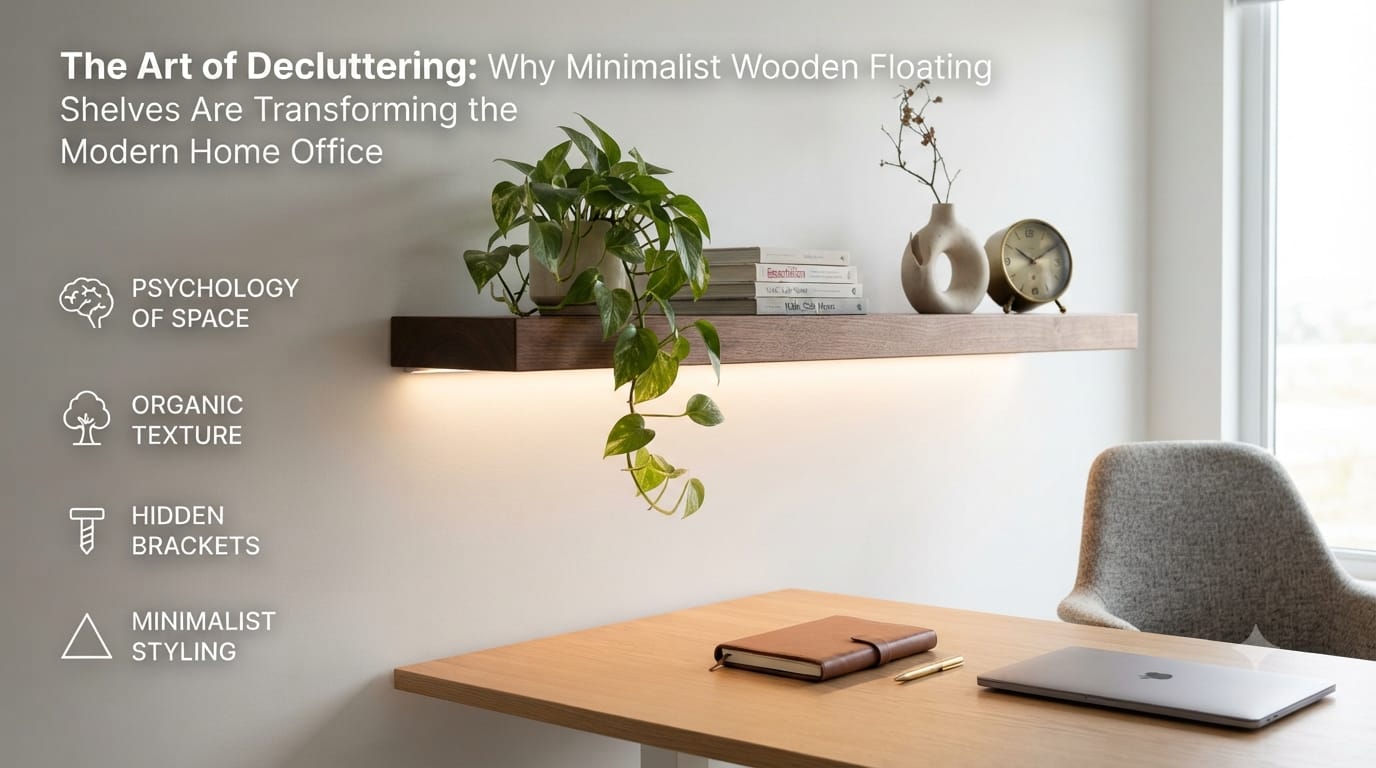
The Art of Decluttering: Why Minimalist Wooden Floating Shelves Are Transforming the Modern Home Office
The modern home office has undergone a radical evolution. Gone are the days of heavy, imposing mahogany desks, towering barrister bookcases, and enclosed cubicles that trap creativity. In their place, a new design philosophy has emerged—one rooted in intentionality, breathing room, and organic warmth. At the epicenter of this shift is a deceptively simple architectural element: the minimalist wooden floating shelf.
To the untrained eye, a floating shelf is merely a plank of wood bolted to a wall. But to the spatial designer, the interior minimalist, and the remote professional striving for deep focus, it is a masterclass in functional art. By freeing up precious floor space and drawing the eye upward, minimalist wooden floating shelves redefine how we interact with our workspaces.
This comprehensive guide explores why these understated fixtures command such profound loyalty, how to select the right wood and finish for your psychological well-being, engineering realities of installation, and avant-garde styling frameworks that turn a blank wall into a masterpiece of productivity.
1. The Psychology of Space: Why Your Home Office Needs to Float
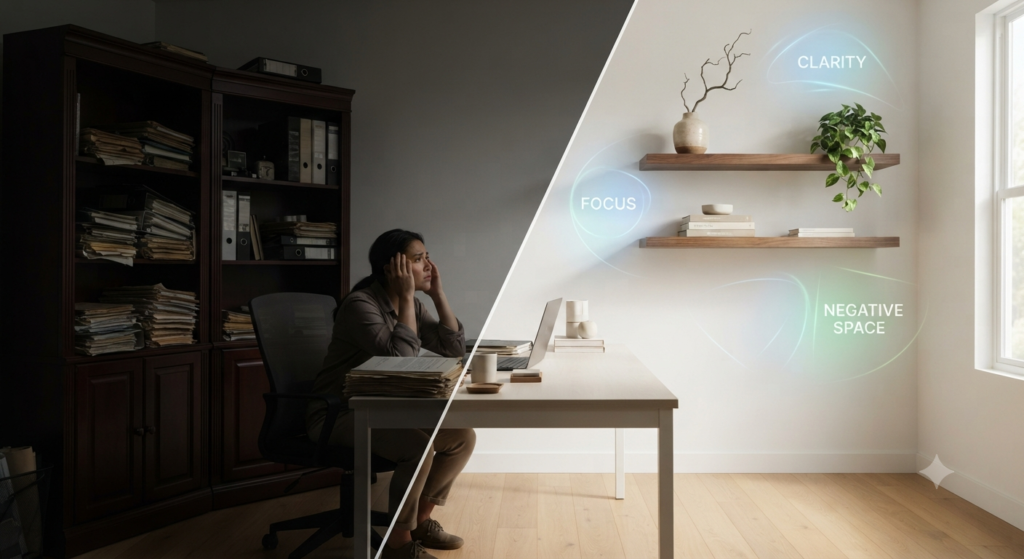
Human psychology is intrinsically linked to our physical environment. The concept of “visual noise”—the constant, low-level cognitive load imposed by cluttered desks, tangled cords, and stuffed storage bins—directly impacts our ability to concentrate. When your workspace is visually chaotic, your prefrontal cortex expends valuable energy filtering out distractions rather than executing deep work.
The Illusion of Expansion
Minimalist wooden floating shelves leverage negative space. By eliminating the vertical side panels and bulky legs of traditional shelving units, floating shelves create an illusion of airiness. The wall behind the shelf remains part of the room’s visual landscape, making even a compact bedroom-turned-office feel expansive.
Grounding Through Organic Textures
While minimalism risks feeling cold or sterile if executed solely with glass, chrome, and white drywall, introducing natural wood counteracts this effect. Wood possesses biophilic properties—innate evolutionary connections to nature. Studies consistently show that incorporating natural wood grain into a workspace reduces cortisol levels, lowers heart rates, and fosters a sense of calm resilience during high-stress professional tasks.
2. Anatomizing the Aesthetic: Choosing Your Wood and Finish
Not all wooden shelves are created equal. When curation meets minimalism, every grain, knot, and edge profile matters. Selecting the correct wood species dictates not only the visual weight of the shelf but also its tactile quality.
Premium Wood Species for the Home Office
- White Oak: The darling of contemporary minimalist design. White Oak features a straight, uniform grain with a light, warm blonde hue. It resists yellowing over time and brings a Scandinavian crispness to a room.
- American Walnut: Rich, dark, and undeniably sophisticated. Walnut introduces dramatic contrast against neutral white or moody charcoal walls. It communicates authority and timeless elegance, making it ideal for executive home offices.
- Hard Maple: Fine-grained, subtle, and durable. Maple offers a clean, creamy appearance with minimal character marks, perfect for ultra-minimalist spaces where uniformity is paramount.
- Reclaimed Timber: For the eco-conscious professional, reclaimed barn wood or scaffolding planks tell a story. The weathered patinas, nail holes, and saw marks inject rustic soul into otherwise sleek, modern offices.
Edge Profiles Matter
In minimalist design, details are amplified. The edge profile of your floating shelf changes its entire character:
- Square Edge: Clean, crisp, and architectural. It emphasizes sharp geometry and modern lines.
- Live Edge: Retaining the natural, undulating contours of the tree trunk. While leaning slightly more organic/rustic, a subtle live-edge shelf can soften a rigid, tech-heavy workspace. Beveled Edge: Tapering inward toward the wall, a beveled edge creates an optical illusion that the heavy wooden plank is paper-thin, enhancing the “floating” magic.

3. Reality: Weight Capacities and Hidden Brackets
A floating shelf is only as good as its hidden support system. The minimalist aesthetic demands that no brackets, L-bars, or visible fasteners distract from the floating illusion. However, home office workers often need to store heavy items: weighty reference books, high-end DSLR cameras, succulent planters, and robust audio gear.
Understanding Internal Hardware
True minimalist wooden floating shelves rely on heavy-duty internal steel brackets. These typically consist of a backplate that screws directly into wall studs, with solid steel rods protruding outward. The wooden shelf is meticulously routed (mortised) on the back to slide seamlessly over these rods.
Crucial Installation Note: Never rely solely on drywall anchors for home office shelving that will hold heavy electronics, ceramics, or dense stacks of paper. Always anchor your floating shelves directly into wooden wall studs (spaced typically 16 inches apart) to ensure zero sag over time. A sagging shelf destroys the illusion of effortless minimalism.
4. Curating the Minimalist Workspace: What to Display (and What to Hide)
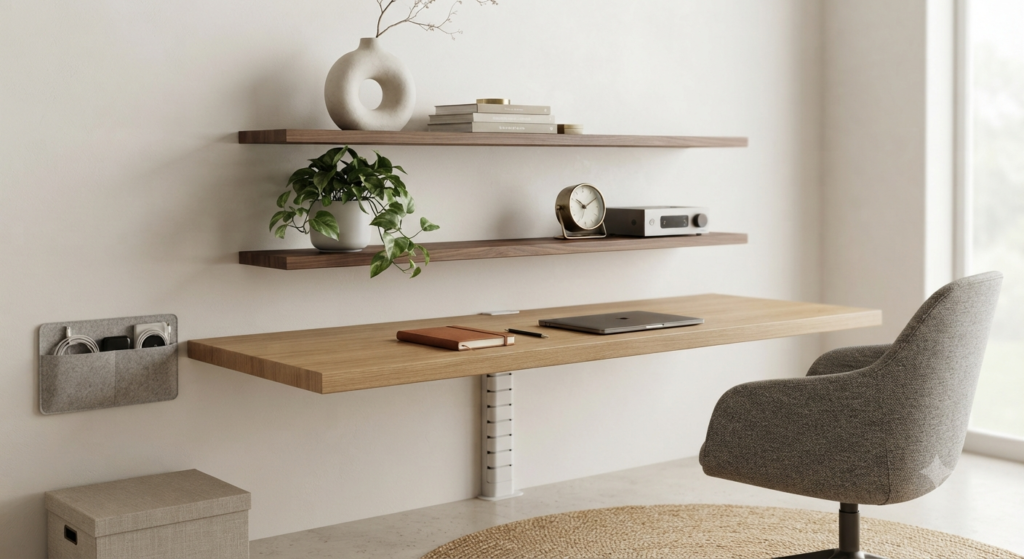
Styling a minimalist floating shelf is an exercise in restraint. The goal is not to fill every square inch of available surface area, but to create balanced compositions of utility and beauty.

The Rule of Three and Asymmetry
Human eyes naturally seek balance, but absolute symmetry can feel clinical and uninspired. Group items in odd numbers (trios are classic) and play with varying heights:
- Height Anchor: Place a tall, slender object on one side—such as a minimalist brass desk lamp or a vertical art print leaning against the wall.
- Mass Anchor: Balance the tall object on the opposite side with a short stack of aesthetic hardcover books topped with a small crystal or decorative object.
- Breathing Room: Leave at least 30% to 40% of every shelf entirely bare. Negative space is a design element in its own right.
Curated Object Categories for the Home Office
- Analog Tools: A sleek vintage notebook, a ceramic jar holding matte black pens, or a mechanical desk calendar.
- Living Elements: A trailing pothos plant or a compact snake plant in a matte white ceramic pot. Plants cleanse the air and inject vibrant life into digital environments.
- Personal Signifiers: A single framed architectural photograph, a treasured souvenir from a research trip, or a sculptural ceramic piece that sparks joy without generating clutter.
5. Lighting as a Design Partner
Floating shelves in a home office do not exist in a vacuum; they interact dynamically with light. Integrating illumination into your shelf design elevates a functional storage piece into an ambient lighting feature.
- Under-Shelf LED Channeling: Many modern woodworkers rout a small groove underneath floating shelves to house warm-toned LED strip lights. Diffused downward glow illuminates the workspace below while casting a soft halo against the wall.
- Picture Lights: Installing a slim, battery-operated or hardwired brass picture light directly above the top shelf creates a museum-like curation effect for your displayed books and art.

6. Sustainable Longevity: Caring for Your Wooden Shelves
Investing in solid wood floating shelves is an investment in generational furniture. Unlike laminate or veneer alternatives that peel and chip, solid wood improves with age, developing a rich patina.
- Finish Selection: Opt for hard-wax oil finishes (such as Rubio Monocoat or Osmo) rather than thick plastic polyurethane coats. Hard-wax oils penetrate the wood fibers, protecting against moisture and stains while maintaining the natural, tactile feel of bare timber.
- Maintenance: Dust weekly with a dry microfiber cloth. Avoid commercial aerosol polishes containing silicone, which leave a synthetic film and attract dust. Annually refresh natural oil finishes with a conditioning balm to keep the wood supple and vibrant.

Conclusion: The Sanctuary of Simplicity
The modern home office is more than just a place to log hours; it is a sanctuary for deep thinking, creation, and professional evolution. By installing minimalist wooden floating shelves, you reclaim your vertical real estate, eliminate desktop clutter, and anchor your digital life in the warm, grounding reality of organic timber.
In a world dictated by endless digital notifications and overwhelming choices, the radical simplicity of a clean wooden shelf floating effortlessly against a wall offers a quiet, daily reminder: less is not an empty space; it is space cleared for what truly matters.